Saturday, February 16, 2013
Louis Béchereau
Louis Béchereau was a French aviation pioneer, born 25 July 1880 and died in Paris on 18 March 1970. He was a contemporary (among others)Clément Ader, Gabriel Voisin, Wilbur Wright Henri Farman and Louis Blériot. In 1902, Béchereau joined a machine shop in Bezons where he participated in the prototype car designed by Clément Ader. With a nephew of Clement Ader in 1903 he created "Construction Company of Aerial Devices."
Armand Deperdussin had entrusted the realization of a plane in 1909 Production Company of Deperdussin Airplanes, with Béchereau as a technical consultant.
Béchereau conceived from the outset devices called "monocoque", the spindle-shaped body very aerodynamic. This feature allows them to achieve performance previously unthinkable.
Its revolutionary design allowed the Deperdussin to win several awards, including the famous Gordon Bennett Aviation Cup in 1912.

Deperdussin Racing Aircraft (1913)
"On April 6, 1913, Marcel Prevost became the first winner of the Schneider Cup. As early as 1912, French designer Bechereau had drawn up the basic plans of the externally braced Deperdussin monoplane, with which Prevost won the Gordon Bennett Cup race from September 27 to 29, 1913. The plane was distinguished by an aerodynamic styling so far ahead of its time that the United States, Great Britain, and Germany withdrew their entries from the Gordon Bennett race. The superiority demonstrated by the Deperdussin seaplane in winning the Schneider Cup doubtless contributed to their decisions."
(source: Conquerors of the Air, The Evolution of Aircraft, 1968, Heiner Emde and Carlo Demand)
For more information, see The Schneider Trophy - 1st Edition April 16, 1913
(source: Conquerors of the Air, The Evolution of Aircraft, 1968, Heiner Emde and Carlo Demand)
For more information, see The Schneider Trophy - 1st Edition April 16, 1913
Saturday, February 9, 2013
1923 Schneider Cup winner
The winner of the 1923 Schneider Cup was D. Rittenhouse of the U.S. in a Navy Curtiss CR-3 The average speed was 177.38 mph. The location of the race was Cowes, England.
Saturday, February 2, 2013
Schneider Cup established in 1912
On December 5, 1912 at an Aero Club de France banquet to award the Gordon Bennett Prize, Jacques Schneider, son of an industrialist, announced that he was founding a new contest. He established an annual race for seaplanes with a prize of 1,000 pounds and a trophy for the winner. The conditions of the race called for a level of precision that added to the race's appeal and would drawn thousands of spectators to the event. The qualifying tests included the following:
The machine also had to stay moored for six hours to prove that it was seaworthy.
The first Schneider Cup race took place in Monte Carlo on April 6, 1913 and a Morane-Saulnier, two Nieuports, and a Deperdussin qualified out of the 24 entries.
(source: Conquerors of the Air, The Evolution of Aircraft, 1968, Heiner Emde and Carlo Demand)
- Each contestant had to move over the water in rough seas beyond he starting line under its own power;
- start and land after executing a loop;
- move on the water under its own power at a minimum velocity of 12 mph over a half-mile stretch between buoys;
- repeat the above procedure;
- then start and land once again.
The machine also had to stay moored for six hours to prove that it was seaworthy.
The first Schneider Cup race took place in Monte Carlo on April 6, 1913 and a Morane-Saulnier, two Nieuports, and a Deperdussin qualified out of the 24 entries.
(source: Conquerors of the Air, The Evolution of Aircraft, 1968, Heiner Emde and Carlo Demand)
Saturday, January 26, 2013
Paper airplane aerodynamics
Interesting and very clear description of paper airplane aerodynamics by John Collins. Collins currently holds the world record for longest flight of a paper airplane.
Saturday, December 15, 2012
Curtiss F6C-1 Hawk - 1926 Schneider Cup Race
 |
| This image is available from the United States Library of Congress's Prints and Photographs division under the digital ID npc2007016207 |
The U.S. Navy Schneider Cup team was photographed on August 19, 1926 in front of the Curtiss F6C-1 Hawk. The pilot was Lt. William Tomlinson (later Rear Admiral, 2nd from left). The Curtiss hawk was powered by a 507 HP Curtiss D12-A engine and achieved a speed of 220.406 km/h during the race but made only the 4th of 4 contenders participating.
Friday, December 7, 2012
Virtual Tour of the National Museum of the US Air Force
 |
| A Virtual Tour of the National Museum of the US Air Force (photo by U.S. Air Force) |
The National Museum of the US Air Force is a large repository
of U.S. military aircraft. Having been there a couple of times, I can attest
that this virtual tour is, of course, no substitute for an actual visit, but it
comes close and is nicely executed. More information on the Virtual Tour, or
click on the link about to go to the tour itself.
Wednesday, November 28, 2012
Curtiss D-12 engine
 |
| Curtiss D-12 engine at the National Museum of the United States Air Force in Dayton, OH -- (U.S. Air Force photo) |
Sunday, November 25, 2012
The Curtiss V-1400 and its link to the D-12
According to William Bevan (New Aircraft Engines, Purdue Engineering Review, Vol. 18-22), the Curtiss V-1400 was developed to meet the requirements for an engine of about 500 horsepower with minimum weight and great reliability The engine had a bore of 4.875 inches; stroke 6.15 inches; and compression ratio 5.5 to 1. It was rated at 510 horsepower at 2,100 rpm. The weight was 660 pounds or 1.3 pounds per horsepower. It was engine was 75 pounds lighter than its nearest competitor in the 500 horsepower class. Both United States Army and Navy racing entered in the Pulitzer and Schneider cup races of 1925 were powered with engine and new world's speed records were established in both races Lieutenant Bettis of the Army Air Service.
According to Hugo T. Byttebier, (The Curtiss D-12 Aero Engine, Smithsonian Annals of Flight, Number 7): “One result of the crystallization of the D-12 design at Curtiss was that demands for more power, which inevitably were to be made, could be met only by enlarging the size of the cylinders in new models, without changing the basic design. We have already encountered the D-12A of 1923, which had had its bore increased by one-eighth inch and was able to develop about 500 bhp for racing. It was not rated for service, however, and only a few units were built. The design of a bigger engine, the V-1400 was started in 1924. It was introduced in the 1925 Pulitzer race, which it had no difficulty in winning, and it did not encounter any worthwhile opposition at the Schneider Trophy contest.”
According to Byttebier, (The Curtiss D-12 Aero Engine, Smithsonian Annals of Flight, Number 7): “The V-1400 had its bore enlarged by another quarter inch (to 4% in.) and its stroke also increased by a quarter inch (to 6V4 in.). This engine gave 620 bhp on the test bench, and it was even lighter than the D-12. The only departure from the basic D-12 design was the important one of using open-ended cylinder liners. The V-1400 passed a 50-hour test at 500 bhp in 1924 but it was not put into production. Twelve units were built, five of which were destined for the P-2 fighter.”
Wednesday, November 21, 2012
Papercraft model of Curtiss RC3-2
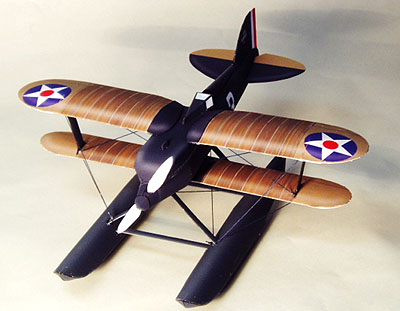 |
| Photo of Curtiss RC3-2 paper model-taken from Japanese site by Takumi. |
Sunday, November 18, 2012
Schilt and the 1926 R3C-2 at Hampton Roads
 |
| Schilt and the R3C-2 at Hampton Roads. (NASM-9A06382). |
During the November 1926 Schneider Trophy competition at Hampton Roads, Virginia, Marine Corps Lt. C. Frank Schilt placed second at an average speed of 372 km/h (231.4 mph) in the R3C-2. Pictured above is Schilt and the R3C-2 at Hampton Roads. (NASM-9A06382). This plane is now displayed in the Pioneers of Flight gallery at the National Air and Space Museum in Washington, DC. For more on the Curtiss R3 racers, see The Curtiss R3C-2 Racer, 1925.
Monday, July 23, 2012
Macchi M.33 powered by D-12 engine
It is interesting to note that the Macchi M.33 in the 1925 race was powered by a 1923 Curtiss D-12 engine rated at 507 horsepower. And it was also the last flying boat to compete in the Schneider races.
Sunday, July 22, 2012
Silent film of the 1925 Schneider Trophy Race
A silent film of the 1925 Schneider Trophy Race
The 1925 race was flown off Bay Shore Park, Maryland, (near Baltimore). Lt. James Doolittle, USA, flying the Army’s entry, a Curtiss R3C-2, was the winner. The U.S. was represented by both Army and Navy entries. According to The Navy's Schneider Cup Racers by Lieutenant Colonel Robert H. Rankin, U.S. Marine Corps, the Army airplane, was the same landplane (designated R3C-1), which had won the Pulitzer Races a few weeks previous to the Schneider contest. Converted to a sea plane by the removal of its wheeled landing gear and the addition of twin floats, it was flown at an average speed of 232.573 m.p.h. to win the contest. An equal-span biplane with a span of 22 feet and a length of 20 feet, two inches, it was powered by a 619-h.p. Curtiss V-1400 liquid-cooled engine.
The British entry was a Gloster Napier III and Italian was a Macchi M.33 Flying Boat.
The 1925 race was flown off Bay Shore Park, Maryland, (near Baltimore). Lt. James Doolittle, USA, flying the Army’s entry, a Curtiss R3C-2, was the winner. The U.S. was represented by both Army and Navy entries. According to The Navy's Schneider Cup Racers by Lieutenant Colonel Robert H. Rankin, U.S. Marine Corps, the Army airplane, was the same landplane (designated R3C-1), which had won the Pulitzer Races a few weeks previous to the Schneider contest. Converted to a sea plane by the removal of its wheeled landing gear and the addition of twin floats, it was flown at an average speed of 232.573 m.p.h. to win the contest. An equal-span biplane with a span of 22 feet and a length of 20 feet, two inches, it was powered by a 619-h.p. Curtiss V-1400 liquid-cooled engine.
The British entry was a Gloster Napier III and Italian was a Macchi M.33 Flying Boat.
Friday, July 13, 2012
Curtiss V 1400 engine of 1925

Tuesday, July 3, 2012
Curtiss R3C-2

The Curtiss R3C-2 flown by U.S. Army Lt. James Doolittle took first place in the Schneider Trophy Race of 1925 with an average speed of 374 km/h (232.17 mph). The plane had a Curtiss V-1400 Engine, a V-type, 12 cylinder, water-cooled engine rated at 665 hp.
Subscribe to:
Posts (Atom)