Saturday, January 26, 2013
Paper airplane aerodynamics
Interesting and very clear description of paper airplane aerodynamics by John Collins. Collins currently holds the world record for longest flight of a paper airplane.

Saturday, December 15, 2012
Curtiss F6C-1 Hawk - 1926 Schneider Cup Race
 |
| This image is available from the United States Library of Congress's Prints and Photographs division under the digital ID npc2007016207 |
The U.S. Navy Schneider Cup team was photographed on August 19, 1926 in front of the Curtiss F6C-1 Hawk. The pilot was Lt. William Tomlinson (later Rear Admiral, 2nd from left). The Curtiss hawk was powered by a 507 HP Curtiss D12-A engine and achieved a speed of 220.406 km/h during the race but made only the 4th of 4 contenders participating.
Friday, December 7, 2012
Virtual Tour of the National Museum of the US Air Force
 |
| A Virtual Tour of the National Museum of the US Air Force (photo by U.S. Air Force) |
The National Museum of the US Air Force is a large repository
of U.S. military aircraft. Having been there a couple of times, I can attest
that this virtual tour is, of course, no substitute for an actual visit, but it
comes close and is nicely executed. More information on the Virtual Tour, or
click on the link about to go to the tour itself.
Wednesday, November 28, 2012
Curtiss D-12 engine
 |
| Curtiss D-12 engine at the National Museum of the United States Air Force in Dayton, OH -- (U.S. Air Force photo) |
Sunday, November 25, 2012
The Curtiss V-1400 and its link to the D-12
According to William Bevan (New Aircraft Engines, Purdue Engineering Review, Vol. 18-22), the Curtiss V-1400 was developed to meet the requirements for an engine of about 500 horsepower with minimum weight and great reliability The engine had a bore of 4.875 inches; stroke 6.15 inches; and compression ratio 5.5 to 1. It was rated at 510 horsepower at 2,100 rpm. The weight was 660 pounds or 1.3 pounds per horsepower. It was engine was 75 pounds lighter than its nearest competitor in the 500 horsepower class. Both United States Army and Navy racing entered in the Pulitzer and Schneider cup races of 1925 were powered with engine and new world's speed records were established in both races Lieutenant Bettis of the Army Air Service.
According to Hugo T. Byttebier, (The Curtiss D-12 Aero Engine, Smithsonian Annals of Flight, Number 7): “One result of the crystallization of the D-12 design at Curtiss was that demands for more power, which inevitably were to be made, could be met only by enlarging the size of the cylinders in new models, without changing the basic design. We have already encountered the D-12A of 1923, which had had its bore increased by one-eighth inch and was able to develop about 500 bhp for racing. It was not rated for service, however, and only a few units were built. The design of a bigger engine, the V-1400 was started in 1924. It was introduced in the 1925 Pulitzer race, which it had no difficulty in winning, and it did not encounter any worthwhile opposition at the Schneider Trophy contest.”
According to Byttebier, (The Curtiss D-12 Aero Engine, Smithsonian Annals of Flight, Number 7): “The V-1400 had its bore enlarged by another quarter inch (to 4% in.) and its stroke also increased by a quarter inch (to 6V4 in.). This engine gave 620 bhp on the test bench, and it was even lighter than the D-12. The only departure from the basic D-12 design was the important one of using open-ended cylinder liners. The V-1400 passed a 50-hour test at 500 bhp in 1924 but it was not put into production. Twelve units were built, five of which were destined for the P-2 fighter.”
Wednesday, November 21, 2012
Papercraft model of Curtiss RC3-2
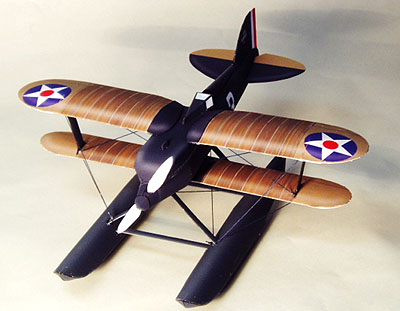 |
| Photo of Curtiss RC3-2 paper model-taken from Japanese site by Takumi. |
Sunday, November 18, 2012
Schilt and the 1926 R3C-2 at Hampton Roads
 |
| Schilt and the R3C-2 at Hampton Roads. (NASM-9A06382). |
During the November 1926 Schneider Trophy competition at Hampton Roads, Virginia, Marine Corps Lt. C. Frank Schilt placed second at an average speed of 372 km/h (231.4 mph) in the R3C-2. Pictured above is Schilt and the R3C-2 at Hampton Roads. (NASM-9A06382). This plane is now displayed in the Pioneers of Flight gallery at the National Air and Space Museum in Washington, DC. For more on the Curtiss R3 racers, see The Curtiss R3C-2 Racer, 1925.
Subscribe to:
Posts (Atom)